
10 Things Everyone Should Know About Hanukkah
What do you know about Hanukkah 2019? Hanukkah is a Jewish winter holiday that celebrates the rededication of a temple in Jerusalem during a revolt against the Seleucid Empire. This time of year, it’s important to remember that Christians, Buddhists, Jewish people, and Pagans all celebrate holidays in December.
Hanukkah is a Jewish holiday commonly referred to as the “Festival of Lights,” since people who celebrate it light a Menorah, a 9-branch candelabra, every night. Strictly speaking the candelabra that is used during Hanukkah is called a Hanukiah. Hanukkah is a fun time for all families who celebrate it.
If you’re not Jewish, you may not know much about Hanukkah aside from latkes and dreidels. Understanding Hanukkah in 2019 better provides you the opportunity to share more than just “fun facts” with your kids. Learning more about how other people celebrate holidays teaches your children empathy and broadens their experience of the world.
We can remember that the close of the year, the start of winter, and the longest night of the year are all times that people celebrate. Cultural celebrations like Kwanzaa and New Year’s Eve (especially in Japan) should also be remembered. It’s easy to center December on Santa and Christianity. It’s good for your kids to know that the world is bigger than that.

It’s Not the “Jewish Christmas”
There are only two (but really only one) obvious similarities between Christmas and Hanukkah: they’re winter holidays, and they (might) involve gifts. But that’s where the parallels end.
While Christmas is a major holiday for Christians; comparatively, Hanukkah is far more minor celebration. Other Jewish holidays are solemnized with restrictions for observant Jews – work is forbidden and people fast. Hanukkah isn’t as restrictive. People work, eat whatever they want, and their only responsibility is lighting the menorah. Hanukkah isn’t even mentioned in the Torah (Jewish Scripture)!
It’s also worth noting that gift-giving during Hanukkah is a fairly new practice. Traditionally, people were more likely to receive Hanukkah gelt (chocolate coins) than an Xbox. The Hanukkah gelt was designed to teach children about the importance of charity, and they may give that gelt to others. And if that’s not a lesson everyone should be teaching their kids, I don’t know what is.
But there are Christmas Menorahs
In 1993, the town of Billings, Montana, saw Jewish and Black families attacked by racists. That December Billings residents of all faiths began putting paper Menorahs in their windows to show support for the free practice of religion and to combat hate. Ultimately, thousands of homes had Menorahs (Hanukiah) in their windows, and a social justice movement was born.

In 1995, PBS aired a project of The Working Group, Not in Our Town, a groundbreaking documentary about the Billings incident. And Not in Our Town evolved into a call to action to stop hate, bullying, and to provide safe and inclusive spaces for all people.
Any family might consider learning about the traditions of Hanukkah in 2019 and respectfully displaying a Hanukiah in their front window, or attending a public lighting of Hanukiah – as a way to show solidarity, combat hate, and bring more light into the world. But always remembering that it carries religious significance and is not just another decorative holiday item.
The books, Christmas Menorah, Shmelf the Hanukkah Elf, and The All-of-a-Kind Family Hanukkah are ones I am sharing with my kids this year. (The All-of-A-Kind Family series of books are charming as all get out and a great way to share Jewish culture with your kids).
Like many December Holidays Hanukkah has its own Traditional Foods

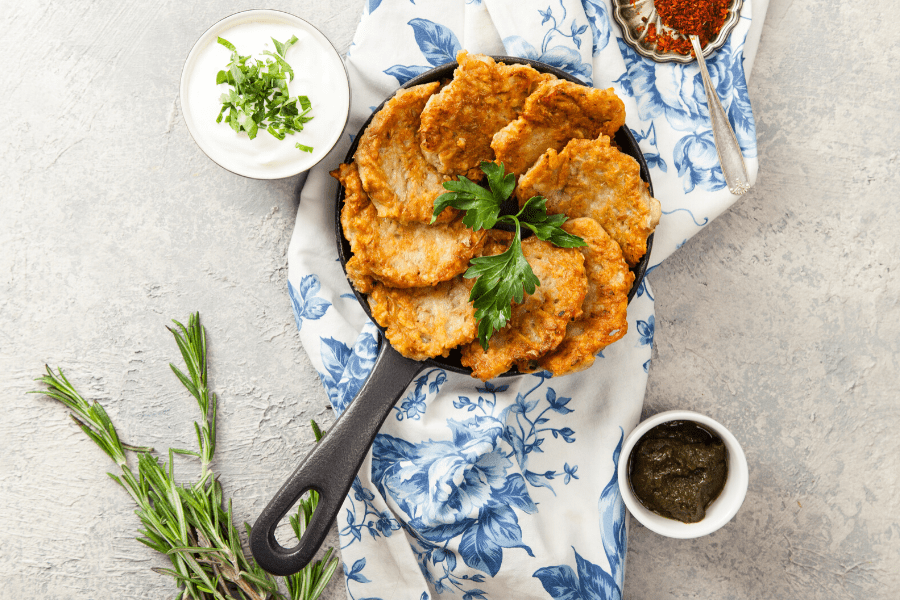
Unlike holidays like Passover, Jewish people eat whatever they want during Hanukkah. There are, however, traditional Hanukkah foods you’re likely to see if you attend a Hanukkah party in 2019. Hanukkah celebrations involve symbolic food items and comfort foods. Especially fried foods. If you visit a Jewish friend’s house for the holidays, you may see latkes (fried potato pancakes), sufganiyot (round jelly donuts), and brisket.
Photo by Elisheva Gohar on Unsplash
Why fried food? I mean other than the obvious – yum. The story of Hanukkah tells Jews that the rededicated temple’s oil menorah stayed lit for a miraculous 8 nights instead of the expected 24 hours. Fried foods are symbolic of the miracle of the oil.
Latkes come in all versions from potato to cheese to everything in between Midlifeboulevard.com has two great recipes for latkes.
Dairy products are also traditional Hanukkah foods (though less so in North America as in other places in the world). Dairy is symbolic of Jewish Hero Judith who used cheese and wine to infiltrate a Babylonian camp, subdue the general, and behead him. In the middle ages, Jewish oral traditions began linking the story of the brave Judith to Judah Maccabee, the hero of the Hanukkah oil story.
By the 14th century, latkes made of cheese became part of traditional food for Hanukkah. Remember potatoes didn’t come to Europe until after the invasion of the “New World.” Many people are unaware of the link between dairy and Hanukkah, despite the plethora of dairy heavy traditional foods found around Hanukkah celebrations.
There Are Several Ways to Spell Hanukkah
“Hanukkah” is a Hebrew word, so any English spelling is just a transliteration. Transliteration is not primarily concerned with representing the sounds of the original but rather with representing the characters, ideally accurately and unambiguously.
You may see the spelling Romanized as Chanukah or Hanukah, too. While there is no absolutely correct way to spell the name of this holiday, any spelling that begins with “H” sounds closer to the intended pronunciation than spellings starting with “Ch.” Hanukkah is also the preferred spelling in the Miriam-Webster dictionary, but most people won’t be quizzing you on that.
While some people may correct you on how you spell Hanukkah, most will not be offended if you spell it differently than they do.
Jewish Holidays Don’t Follow the Calendar We’re Used To
All Jewish holidays exist on a lunisolar calendar, whereas most people don’t even know that there is anything other than the Gregorian calendar. On the Jewish calendar, Hanukkah begins on the same night each year – the 25th of Kislev. On the Gregorian calendar, this date could fall anywhere from late November to late December, with the final night sometimes entering January. That’s because the differences between lunar and solar cycles throw the calendar off by nearly 11 days each year.
In 2019, Hanukkah begins on December 22nd. It will begin on December 10th in 2020 and November 28th in 2021. The differences in the Gregorian and Jewish calendars mean that the year 3031 will not have a Hanukkah celebration, and Hanukkah will hardly ever begin in January until 3450 (then, it’ll be roughly every 50 years). Despite the difference in calendars, for all practical purposes, this means you can always expect it to begin before the new year rolls around.
Hanukkah is 8 Nights Long, Not 8 Days Long
The difference between the two may confuse some people, but all Jewish holidays begin at sundown. In 2019, Hanukkah begins on December 22nd, but not until nightfall. For the rest of Hanukkah, it doesn’t matter whether it’s daytime or not – it’s still Hanukkah. Hanukkah ends eight nights later on December 30th, but Jewish people won’t light the menorah that night. The 8 branches of the menorah will have been completely lit the night before, on the 29th.
There are Hanukkah Songs
Hanukkah songs are not simply re-written Christmas songs. The holiday has both traditional and modern tracks of its own. The Dreidel Song (also known as “I Had a Little Dreidel”) is one of the most well-known Hanukkah songs today. You may have also heard Hanukkah, Oh Hanukkah, which was originally sung in Yiddish. The Barenaked Ladies even covered it!
Of course, we mustn’t forget about Adam Sandler’s Hanukkah song collection. He released the first song in 1994 and the most recent track in 2015. He wrote these songs due to a lack of Hanukkah songs in pop culture, and each song name-drops different Jewish celebrities. They’re appropriate for teenagers and adults.
Some Hanukkah Traditions Simply Exist for the Sake of Inclusion
Around the 19th century, the commercial nature of Christmas escalated. Jewish children began to feel excluded by their Christian peers. Rabbis addressed this by framing Hanukkah as a joyous winter holiday to include Jewish kids in traditional holiday fun. The holiday gained prominence in America society to address Jewish kids feeling excluded!
The same can be said about presents. As mentioned earlier, Hanukkah didn’t traditionally involve large gifts. Many Jewish families added gift-giving to their holiday traditions to reduce resentment from kids. You can find my rundown of Oprah’s favorite holiday gifts here which includes many great ideas for Hanukkah gifts from small to large
Some Jewish American families even put up a Hanukkah bush.
Hanukkah Gifts Aren’t Always Huge
Remember, there are 8 nights of Hanukkah! That means parents who give gifts need to find multiple presents for the holidays. Each family has their own traditions for gifts. Some families keep all gifts small, others give small gifts and one large gift, while others will simply give one large gift.
The Candles on the Menorah Serve a Purpose – and part of that purpose is to demonstrate to others the free practice of religion
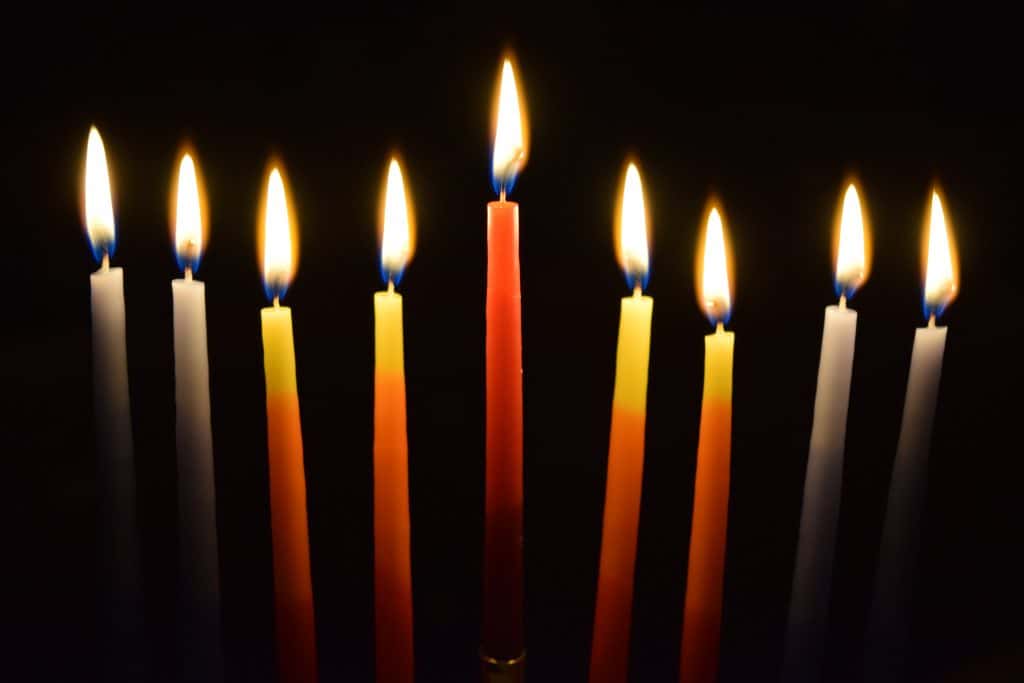
While there are 8 nights of Hanukkah, there are 9 branches on a menorah. The middle branch holds the shammash, a candle that’s used to light all of the others. After securing each candle in the menorah, many Jewish people will light the shammash with a match or a lighter. Then, they light all of the others using the flame from the shammash before placing it in the middle branch.

The light from the menorah is specifically for the purpose of publicizing and meditating on the miracle. As such, they are often displayed in windows to remind the greater world of the miracle. In the USA, starting in the 1970s, the public lighting of menorahs became part of the tradition.
Blessings are said when the candles are lit. Hymns are recited or sung after the blessing. At this time many families exchange gifts. Some families use this as a chance to teach their children about charity and encourage children to engage in Tzedakah. This carries a deeper meaning than common exchanges of goodwill or dropping money in a bucket. Tzedakah is a religious and ethical obligation.
It’s All Up for Interpretation
The condensed version of the story of Hanukkah is as follows: after the enemy occupation of the Temple in Jerusalem, it is discovered that only one day’s worth of sanctified ritual olive oil remained to light the menorah in the temple. Despite this, the lights burned for eight nights, until additional oil could be pressed and made ready.
Jewish rabbis, scholars, and followers all have different interpretations of the foundational events. Some Jewish scholars have suggested that the first night of Hanukkah was actually just a belated Sukkot celebration, since the revolt prevented Jews from celebrating it.
While Hanukkah oftentimes framed as a fight for religious freedom. Some consider it a battle between traditional Jews and those who assimilated into the culture of their surroundings. There is also a militaristic element to that, depending on the era, either holds more or less prominence.
The most commonly accepted reason for the holiday, however, is the celebration of religious freedom. And as Americans, this is a value worth celebrating by all means.
Hanukkah is a minor religious holiday with lots of cultural significance in the Western world. Its rise to popularity wasn’t random, nor are the holiday traditions we associate with it. If you have a chance to attend a Hanukkah celebration, offer to bring applesauce for the latkes or some round jelly donuts – the host will likely appreciate it! Or check out this great post about Hanukkah Hostess gifts from Midlifeboulevard.com
I think this year, for 2019, our family will include attending our community Hanukiah lighting, check out and read some books about Hanukkah.
Leave a Reply